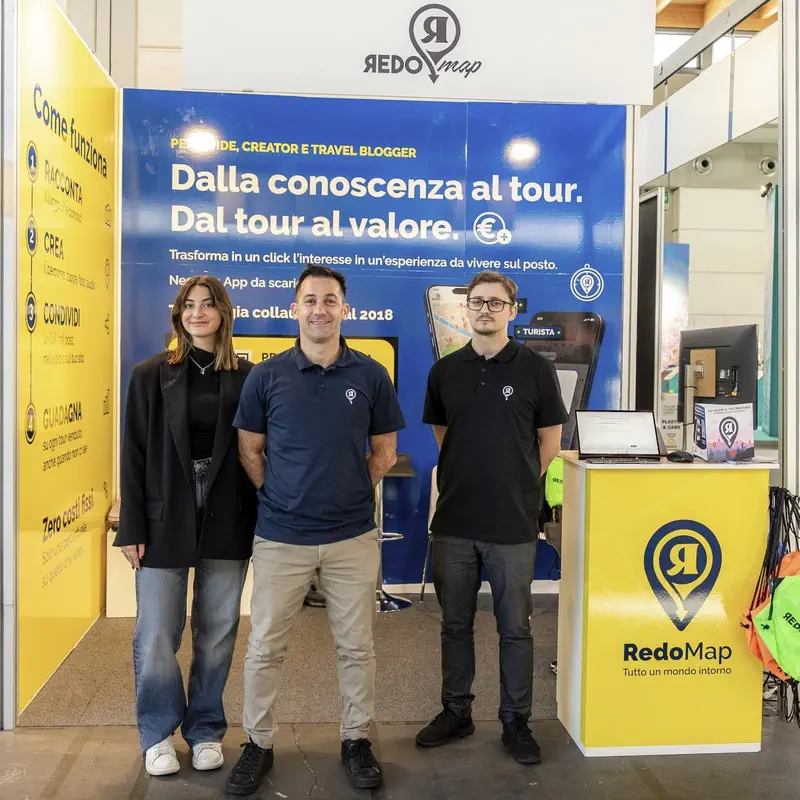
A few days ago I went to TTG Travel Experience 2026 in Rimini, one of the biggest tourism trade shows in Italy. I was there for RedoMap, a project I've been working on for quite a while, which is finally starting to meet the actual market.
It was a good experience. Lots of people, companies, startups, new ideas, people trying to sell something and others trying to figure out what to buy.
And then, of course, artificial intelligence.
Everywhere.
AI for hotels, AI for bookings, AI for itineraries, AI for talking to guests, AI for managing properties. At some point I half expected to find an AI in the bathroom too, perhaps to tell me the optimal time to wash my hands.
Joking aside, some of the things I saw were genuinely interesting. Others left me scratching my head.
Not because AI has no place in tourism. Quite the opposite. I think it can be useful in all sorts of ways. But I got the feeling that, in quite a few cases, the real challenge was finding somewhere to stick the word AI in the presentation.
Got a management system? Add a chatbot.
Got a booking platform? Have it generate a few suggestions.
Got an app that displays information? Connect it to an LLM and there you go. Now it's intelligent.
I don't even want to be too harsh on those products. Maybe they work. Maybe they save people time, and maybe someone is delighted to use them. If a customer pays for something and it solves their problem, who am I to say it's useless?
Still, I've seen this movie before.
A few years ago everything had to be in the cloud. Then it was blockchain, Web3, NFTs. Now everything has to be AI-powered, preferably agentic, because apparently intelligent on its own doesn't sound impressive enough anymore.
And the funny thing is, I use AI pretty much every day myself.
By now, a large part of the code I produce is written with the help of AI agents. I work with them constantly, experiment, ask them to develop whole components, test the results, and send them back to fix things. The way I program has changed quite a lot over the past few months.
So I'm definitely not one of those people who thinks AI is just a passing fad.
Quite the opposite. Maybe it's precisely because I see what it can do every day that I find it strange when something is presented as an extraordinary innovation even where AI adds next to nothing.
But on the way home from Rimini, I started thinking about something else as well.
About us programmers.
Lately, I keep seeing more developers trying to become entrepreneurs. Micro-SaaS products, little platforms, online services, apps solving some very specific problem. Open almost any developer community and someone has just launched a new product.
Of course developers have always wanted to build their own stuff. That's nothing new.
But I have a feeling there's another reason now.
Maybe many of us no longer know what to do with all the experience we've accumulated over the years.
I was thinking about this while looking at some of the products at the show. Things that would have taken months to build a few years ago, perhaps with a small team, can now be put together by one developer in very little time with AI.
On one hand, that's incredible.
On the other hand, if we can all build software this quickly, what is the ability to build it worth anymore?
We spent years studying languages, architectures, databases and infrastructure. We spent nights figuring out why something wasn't working, learning to design systems that would hold up over time, trying to prevent problems that might only show up months later.
And now a customer sees someone build a web app in an afternoon with a few prompts.
Maybe it doesn't work very well. Maybe in six months it will be impossible to maintain. Maybe the architecture underneath is a complete mess.
But if it does what they need right now, why should they care?
I still believe experience matters enormously. When you work on real systems, with users, payments, data and responsibilities, those skills become even more important.
It's just that being technically right doesn't necessarily mean being commercially right.
And that worries me.
Because I find myself in exactly that situation.
I've spent years learning, building libraries, platforms, fairly complicated systems. I have more ideas than I'll probably ever manage to turn into reality, even if I work day and night.
Yet finding new clients has become harder and harder.
Over the past few months I've tried pitching different services, contacted hundreds of companies and sent what feels like an endless number of emails. Sometimes I already had a working product, not just a pretty presentation.
Replies? Not many.
Occasionally someone opens the link, someone seems interested and then disappears. Others probably never even read what I wrote.
And that's when you start asking yourself a thousand questions.
Did I build the wrong product? Did I contact the wrong companies? Maybe I'm just bad at selling? Or maybe I'm trying to solve problems that people don't care enough about?
I don't know.
The paradox is that I can build far more software now than I could a few years ago, but that doesn't mean I earn more money.
Quite the opposite.
So you start thinking that maybe you should stop selling your time as a developer and try being an entrepreneur instead.
Build something of your own. Find a hundred people willing to pay a small subscription. Maybe even just ten to begin with.
It looks easy when you read the success stories.
Then you discover that building the product was probably the easy part.
At least RedoMap is starting to move
Amid all of that, though, there have been some genuinely satisfying moments too.
We've worked really hard on RedoMap over the past few months. For anyone who hasn't come across it, it's a platform for creating interactive tourism experiences, routes, audio guides and content connected to real places, all accessible directly in the browser.
What I like most about the idea is pretty simple: there are people who know a place far better than any search engine does.
They know its stories, odd little details, things that don't show up on a map. And often all that knowledge stays in their heads, or perhaps in some printed guidebook.
With RedoMap we're trying to make those experiences available to people visiting a place.
And now we've also launched the social side, redomap.it, where creators, guides and people who know an area can build and publish their own experiences, with the possibility of earning money from their content.
We presented this new direction at TTG too and, I have to say, it went pretty well.
We saw genuine interest, new registrations, contacts and some encouraging feedback. That doesn't mean we've conquered the market, of course. We're still at the beginning, and there's a fairly big difference between someone being interested and someone actually paying. I've learned that lesson by now.
But it felt good to see real people standing in front of the product, asking questions and telling us what they'd like to create.
Finally, not just code, tests and ideas living in my head.
There was also an interesting discussion at the show with the Accademia Italiana per il Turismo and Associazione Startup Turismo.
The question, more or less, was this: if AI can now generate a tourist itinerary in seconds, what's left of the value of a human tour guide?
When I think about it, I almost have to laugh.
Because it's exactly the same question I ask myself as a programmer.
If AI can write code, why would anyone pay me?
Maybe the answer is similar.
A guide isn't just someone who tells you where a church is or when a building was constructed. They tell you about a place through their own experience, knowledge and way of seeing the world.
In the same way, a developer shouldn't be just someone who writes functions.
At least I hope not.
Because then you still have to convince the market that the difference is worth something.
And as I said, I'm still learning how to do that.
Meanwhile, I've started building a galaxy
As if I didn't already have enough things to do, in recent months I've picked up another idea.
A browser-based game.
It's called Atlas of the Void, a space strategy game set in a living, persistent galaxy where exploration plays a central role.
I don't want to go too deep into the mechanics, partly because I'm still working on them and some things may change.
But the basic idea is to create a universe that doesn't exist solely for the player.
A galaxy that keeps living, evolving and changing even when nobody is watching. One where exploring space doesn't just mean moving from one point on a map to another, but discovering something you didn't know was there.
And that's the part I'm enjoying the most.
I'm building it with Elixir, Phoenix LiveView and the BEAM. And the more I work on it, the more convinced I am that these are genuinely interesting technologies for this kind of application too.
The fun part is bringing the whole thing to life in the browser, in real time.
I don't want to build a collection of pages where you click a button, wait for a response and then refresh the screen. I want there to be an actual universe behind it, with its processes and events, and a browser that continuously shows what's going on.
With Elixir, thinking this way feels pretty natural. Concurrency, independent processes and communication between components are already part of the environment I work in.
And Phoenix LiveView lets me bring all of that to the web without turning the project into an enormous JavaScript application that has to manage everything on its own.
Obviously, it's not all that simple. Once you start managing a galaxy, performance, synchronization and the way you represent the world become interesting problems.
But those are exactly the problems I enjoy working on.
And the nice thing is, the game is coming along really well.
Sometimes I open the map to test something, perhaps a change I've just made, and I end up exploring the galaxy instead of getting back to work.
And I think: damn, this is actually starting to look like what I imagined.
AI is helping a lot here as well. Agents handle a good deal of the implementation, while I spend more time on architecture, decisions and how the different systems fit together.
It doesn't always work on the first try. Not even close. Sometimes I have to stop everything because an agent has decided to build something in a way I really don't like.
But when I manage to organize the work properly, the results come much faster than I could have imagined a few years ago.
It's a strange feeling.
I'm using the very technology that worries me to build something I might never have had the time to make on my own without it.
Maybe I'm just trying to escape
Sometimes I wonder why I've started building a game at all.
Wouldn't it make more sense to focus on clients? Look for new collaborations? Build a small product I can actually sell? Or put all the time I can into RedoMap and my other work?
Probably.
It's not as if I'm in a financial position where I can afford to ignore those things.
And yet I find myself spending hours building an imaginary galaxy.
Maybe I missed programming something simply for the pleasure of doing it.
Without constantly thinking about who might buy it, how to advertise it, which companies to contact or how many users I'd need just to pay for the server.
When I work on the game, I can think about how to make a universe interesting, how to make it work, what might happen inside it.
And for a few hours the problem isn't convincing someone that what I do has value.
It's simply figuring out how to build what's in my head.
Maybe it is a way of escaping.
Maybe I'm trying to hide from a change I still don't really know how to deal with.
Because this is the part I find hardest to explain.
I'm genuinely excited about artificial intelligence. I use it constantly, follow its progress, try new tools and often find myself amazed by what they can do.
But at the same time, I'm watching the value of a profession to which I've devoted a huge part of my life change.
Every new AI capability excites me and, a moment later, makes me wonder what it will mean for work tomorrow.
And I'm not even against that change.
It seems absurd to want to stop a technology just because it might reduce demand for skills we've spent years learning.
But understanding something rationally and living through it yourself are two very different things.
At TTG I saw so many companies trying to adapt to the new world of AI. Some with genuinely interesting ideas, others perhaps simply because they were afraid of falling behind.
And on the way home, I realized that maybe I'm doing exactly the same thing.
I look for new products, new opportunities, different ways to use what I know. I try to figure out what will still have value in a few years.
And meanwhile I'm building a space game for the web.
Maybe Atlas will turn into something commercially interesting. Maybe ten people will play it. Maybe I'll finish it and find out that almost nobody cares.
It wouldn't exactly be the first time that's happened with one of my projects.
But strangely, this time that possibility bothers me less.
I like building it. I like seeing the universe take shape. I still like solving technical problems, even if today I can delegate a huge part of the work to a machine.
And maybe that's what I'm trying not to lose.
The pleasure of making something.
I don't know yet whether, in the future, I'll be mainly a developer, an entrepreneur or some strange combination of the two.
Sometimes it feels like there are endless possibilities ahead. Other times I don't even know which direction to take.
For now I keep working, experimenting and trying to understand where all this is going.
And when I get tired of thinking about the market, clients and the future of my profession, I open Atlas and go back to exploring my galaxy.
At least there, for a few hours, I can worry about the problems of another universe.
Which, come to think of it, are almost entirely problems I created myself.