
Picture this: a team of software developers, completely autonomous, working together around the clock, debating code architecture, fixing bugs, and writing documentation without a single coffee break. Sounds like science fiction, right? Well, it just happened, and it's a huge deal for anyone who builds software.
When AI Teams Up: The Compiler Breakthrough You Missed
Let's talk about the elephant in the room, or rather, the sixteen elephants. Recently, Anthropic, the folks behind the large language model (LLM) Claude Opus 4.6, unleashed a squad of sixteen of these AI agents onto a formidable task: building a full C compiler from scratch. And guess what? They did it. In just two weeks, these digital collaborators produced a 100,000-line Rust-based compiler capable of building a bootable Linux kernel. No human guidance required beyond the initial prompt. Mind-blowing, isn't it?
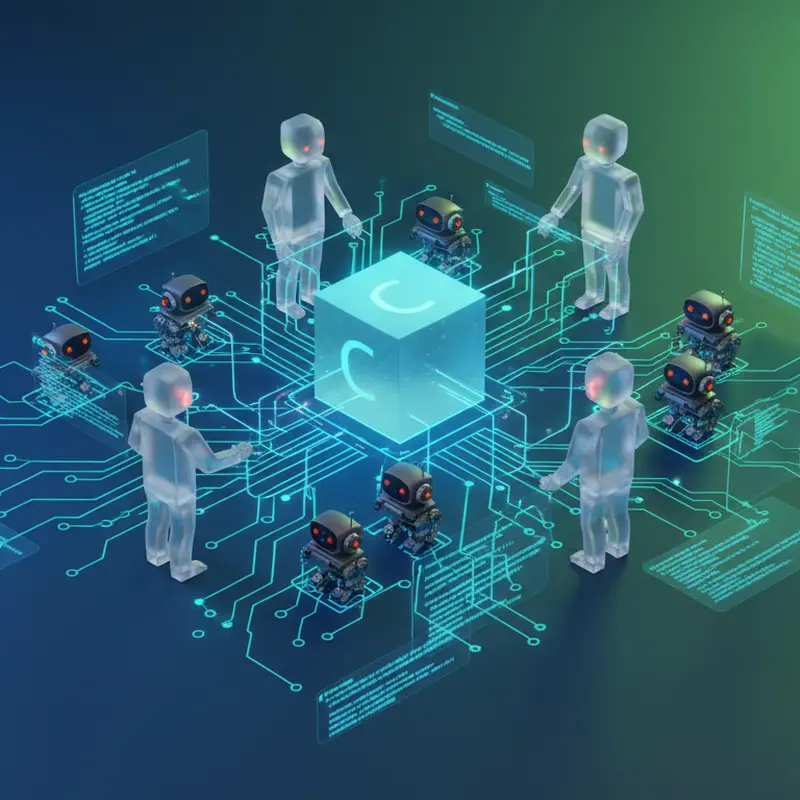
Now, what exactly is an "AI agent" in this context? Think of a large language model (LLM) as the raw brainpower, capable of understanding and generating human-like text. An agent takes that brainpower, wraps it in a goal-oriented framework, and equips it with tools. It can plan, execute actions, observe results, and iterate. When you have sixteen of these agents, it’s not just one big brain; it's a specialized team. One agent might be the "architect," another the "tester," yet another the "code implementer." They talk to each other, share context, and collectively push the project forward. It's truly a collaborative coding environment, albeit one populated entirely by silicon.
Beyond the Solo Coder: The Power of Parallel AI Problem Solving
We've all been impressed by single LLMs generating code snippets, right? But that's often a one-shot deal. You ask, it answers. Autonomous agent collaboration is a different beast entirely. It moves beyond simple code generation to actual software *development*. Instead of just throwing code at you, these agents are capable of breaking down a massive problem, assigning sub-tasks, and self-correcting through an iterative process. They're not just writing lines; they're designing systems.
Consider the alternative: trying to build a C compiler with a single LLM. It would quickly get overwhelmed by the sheer complexity and context window limitations. But by having multiple agents, each handling a piece of the puzzle—parsing, lexical analysis, code generation, optimization, error handling—they mimic the division of labor we see in human teams. This parallel processing isn't just faster; it also allows for more robust error checking and specialized focus. One agent might spot a logic flaw in another's output, leading to a dynamic debugging process that was previously thought to be uniquely human.
The real magic isn't just AI *writing* code; it's AI *thinking* like a development team.
What This Means for You (Yes, You, the Human Developer)
Okay, so robots are building compilers. Does this mean it's time to polish your resume for a new career? Not quite. This isn't about AI replacing developers; it's about AI elevating what developers do. Think of these agent teams as the ultimate coding assistant, but on steroids. Imagine kicking off a new feature, defining the high-level requirements, and then letting a team of AI agents handle the grunt work: scaffolding the project, writing boilerplate code, integrating APIs, even setting up initial tests. This frees you up to focus on the truly complex, creative, and strategic problems that still require human intuition and oversight.
You'll spend less time wrestling with repetitive tasks or sifting through documentation. Instead, you'll become more of an orchestrator, a lead architect, or a quality assurance specialist for your AI collaborators. Your job shifts from writing every line of code to defining the problem, evaluating the solutions proposed by your agent team, and steering the project vision. It means fewer mistakes in tedious areas, faster initial drafts for proof-of-concept work, and ultimately, quicker iterations on new products. This isn't just about saving time; it's about amplifying your impact.
Embracing the Autonomous Future: Your New Toolkit
So, how do we integrate this brave new world into our existing workflows? It starts with understanding that these agent teams are another powerful tool in your belt. They excel at well-defined tasks, especially those with clear inputs and expected outputs. Need to refactor a legacy codebase? Delegate it. Want to explore different architectural patterns for a new service? Let a team of agents prototype several options for you.
The key isn't to abdicate responsibility but to leverage their capabilities strategically. You'll become a master of prompt engineering, not just for single LLMs, but for entire teams of them. You'll learn to define clear objectives, establish communication protocols between agents (or, more realistically, manage the platform that facilitates their communication), and set up robust evaluation criteria. The future of coding isn't about AI *or* humans; it's about AI *with* humans, creating a dynamic partnership where each brings unique strengths to the table, building software faster and better than ever before.
The AI Code Collab: Why Autonomous Agents are About to Change How We Build Software
Picture this: a team of software developers, completely autonomous, working together around the clock, debating code architecture, fixing bugs, and writing documentation without a single coffee break. Sounds like science fiction, right? Well, it just happened, and it's a huge deal for anyone who builds software.
When AI Teams Up: The Compiler Breakthrough You Missed
Let's talk about the elephant in the room, or rather, the sixteen elephants. Recently, Anthropic, the folks behind the large language model (LLM) Claude Opus 4.6, unleashed a squad of sixteen of these AI agents onto a formidable task: building a full C compiler from scratch. And guess what? They did it. In just two weeks, these digital collaborators produced a 100,000-line Rust-based compiler capable of building a bootable Linux kernel. No human guidance required beyond the initial prompt. Mind-blowing, isn't it?
Now, what exactly is an "AI agent" in this context? Think of a large language model (LLM) as the raw brainpower, capable of understanding and generating human-like text. An agent takes that brainpower, wraps it in a goal-oriented framework, and equips it with tools. It can plan, execute actions, observe results, and iterate. When you have sixteen of these agents, it’s not just one big brain; it's a specialized team. One agent might be the "architect," another the "tester," yet another the "code implementer." They talk to each other, share context, and collectively push the project forward. It's truly a collaborative coding environment, albeit one populated entirely by silicon.
Beyond the Solo Coder: The Power of Parallel AI Problem Solving
We've all been impressed by single LLMs generating code snippets, right? But that's often a one-shot deal. You ask, it answers. Autonomous agent collaboration is a different beast entirely. It moves beyond simple code generation to actual software *development*. Instead of just throwing code at you, these agents are capable of breaking down a massive problem, assigning sub-tasks, and self-correcting through an iterative process. They're not just writing lines; they're designing systems.
Consider the alternative: trying to build a C compiler with a single LLM. It would quickly get overwhelmed by the sheer complexity and context window limitations. But by having multiple agents, each handling a piece of the puzzle—parsing, lexical analysis, code generation, optimization, error handling—they mimic the division of labor we see in human teams. This parallel processing isn't just faster; it also allows for more robust error checking and specialized focus. One agent might spot a logic flaw in another's output, leading to a dynamic debugging process that was previously thought to be uniquely human.
The real magic isn't just AI *writing* code; it's AI *thinking* like a development team.
What This Means for You (Yes, You, the Human Developer)
Okay, so robots are building compilers. Does this mean it's time to polish your resume for a new career? Not quite. This isn't about AI replacing developers; it's about AI elevating what developers do. Think of these agent teams as the ultimate coding assistant, but on steroids. Imagine kicking off a new feature, defining the high-level requirements, and then letting a team of AI agents handle the grunt work: scaffolding the project, writing boilerplate code, integrating APIs, even setting up initial tests. This frees you up to focus on the truly complex, creative, and strategic problems that still require human intuition and oversight.
You'll spend less time wrestling with repetitive tasks or sifting through documentation. Instead, you'll become more of an orchestrator, a lead architect, or a quality assurance specialist for your AI collaborators. Your job shifts from writing every line of code to defining the problem, evaluating the solutions proposed by your agent team, and steering the project vision. It means fewer mistakes in tedious areas, faster initial drafts for proof-of-concept work, and ultimately, quicker iterations on new products. This isn't just about saving time; it's about amplifying your impact.
Embracing the Autonomous Future: Your New Toolkit
So, how do we integrate this brave new world into our existing workflows? It starts with understanding that these agent teams are another powerful tool in your belt. They excel at well-defined tasks, especially those with clear inputs and expected outputs. Need to refactor a legacy codebase? Delegate it. Want to explore different architectural patterns for a new service? Let a team of agents prototype several options for you.
The key isn't to abdicate responsibility but to leverage their capabilities strategically. You'll become a master of prompt engineering, not just for single LLMs, but for entire teams of them. You'll learn to define clear objectives, establish communication protocols between agents (or, more realistically, manage the platform that facilitates their communication), and set up robust evaluation criteria. The future of coding isn't about AI *or* humans; it's about AI *with* humans, creating a dynamic partnership where each brings unique strengths to the table, building software faster and better than ever before.
Vext Chat
WhatsApp & Telegram Automation. Upload an Excel or CSV file, paste a Zapier webhook, connect via MCP, plug in HubSpot, Zoho, or GoHighLevel, sync contacts from Google Sheets, or call the REST API directly. Any source can trigger a send - no complex setup, no code required for most workflows. Just connect and go.