
Jensen Huang, Nvidia's CEO, recently tossed a hand grenade into the developer community. He suggested the most powerful programming language of the future won't be Python or C++. It'll be English. Your reaction likely ranged from a nod of "of course" to a resounding "over my dead keyboard." Let's unpick that, because he's not entirely wrong, and the implications for how we engineer are massive.
Beyond Syntax: The Intent-Driven Machine
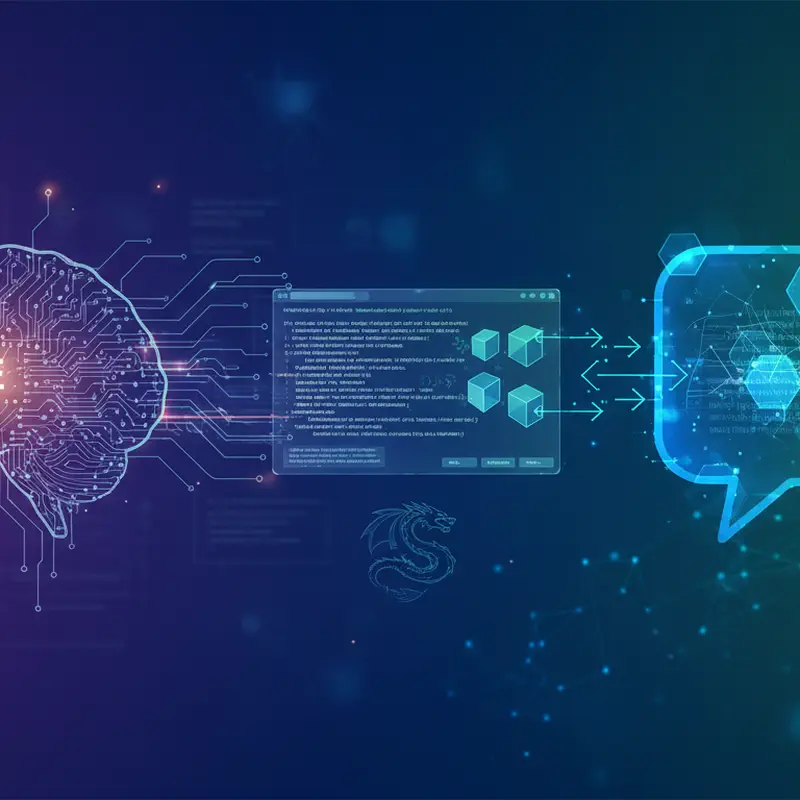
Think about it. We’ve always strived for higher levels of abstraction. From machine code to assembly, then to C, Java, Python. Each step pushed us further from the metal, letting us express intent more naturally. Huang's vision simply takes that trajectory to its logical (and somewhat terrifying) extreme. It’s not about typing "print('Hello, world!')" anymore. It's about saying, "Show me a greeting." The heavy lifting of translating that human desire into executable steps shifts to a new kind of interpreter: the Large Language Model, or LLM.
This isn't just about code generation. It’s about interaction. Imagine a future where your debugging session involves asking the system, "Why is this microservice hanging on startup after deserializing a malformed JSON payload?" And the system replies, "Ah, line 347 in the `DataProcessor.java` file is expecting an array, but received a single object. Here’s a diff to fix it." This isn't science fiction; it's the direction we're heading, powered by increasingly capable AI tools integrated directly into our workflow.
The Illusion of Simplicity: Where Natural Language Hits Reality
Sounds great, right? Fewer obscure error messages, faster feature delivery. But here's the catch, and it's a big one: natural language is gloriously, frustratingly ambiguous. Ask five people to describe "a red car," and you'll get five slightly different mental images. Ask an LLM to "build me a secure, scalable e-commerce platform," and you're entering a world of hurt. Precision is paramount in engineering, and natural language actively resists it.
We're talking about deterministic systems that need exact instructions. A missed semicolon can break an application. What happens when your natural language instruction is interpreted slightly differently than your intent? How do you debug a hallucination? How do you ensure performance when the underlying code is generated with a 'good enough' approach rather than explicit optimization directives? These are not trivial problems. The dream of "just talk to the computer" glosses over the fundamental challenge of aligning human vagueness with machine exactitude.
The real power isn't in replacing code with English, it's in using English to command intelligent agents that then write, optimize, and validate the code. We're not losing a language; we're gaining an orchestrator.
Engineering for the Age of Intent: New Skill Sets, New Standards
So, what does "good" look like in this English-as-programming-language future? It definitely doesn't mean engineers become obsolete. Instead, our roles evolve. We become architects of prompts, validators of generated solutions, and experts in refining intent. The focus shifts from memorizing API signatures to crafting crystal-clear specifications. We'll need to develop a new rigor in how we articulate requirements and desired behaviors to these intelligent systems.
Think about "prompt engineering" not as a niche skill, but as a core competency. It's about understanding the nuances of language, anticipating potential ambiguities, and providing contextual guardrails. We'll be setting up robust validation frameworks, automated testing pipelines, and performance monitoring tools that scrutinize the output of these AI systems, not just our hand-written code. The engineering discipline moves up the stack, from telling the computer *how* to do something, to explicitly defining *what* needs to be done, under what constraints, and with what quality metrics.
The Hybrid Reality: English as a Productivity Layer, Not a Replacement
Ultimately, Huang's prediction isn't about English entirely replacing Python or Rust. It's about English becoming a powerful *interface* to them. You'll still have those underlying, highly optimized, symbolic languages doing the heavy lifting. But the initial interaction, the rapid prototyping, the generation of boilerplate, the refactoring suggestions – that will increasingly be driven by natural language commands interpreted by an LLM.
This means your job isn't to stop learning programming languages. It's to learn how to effectively leverage AI to write them faster, debug them smarter, and operate at a higher plane of abstraction. Engineers who can bridge the gap between human intent expressed in natural language and the precise, deterministic requirements of software systems will be the ones leading the charge. You'll use English to instruct your AI assistant to draft a new microservice endpoint, then you'll dive into the generated code to optimize, secure, and integrate it perfectly. It's not the end of programming; it's the next level of programming with a very powerful, albeit sometimes quirky, copilot.
Vext Chat
WhatsApp & Telegram Automation. Upload an Excel or CSV file, paste a Zapier webhook, connect via MCP, plug in HubSpot, Zoho, or GoHighLevel, sync contacts from Google Sheets, or call the REST API directly. Any source can trigger a send - no complex setup, no code required for most workflows. Just connect and go.